Association of Dietary Energy Density with Macronutrient and Fiber Intake among Women with Central Obesity in a Community-Based Group Exercise
DOI:
https://doi.org/10.58184/miki.v4i2.1060Keywords:
dietary energy density, central obesity, fiber, women, macronutrientsAbstract
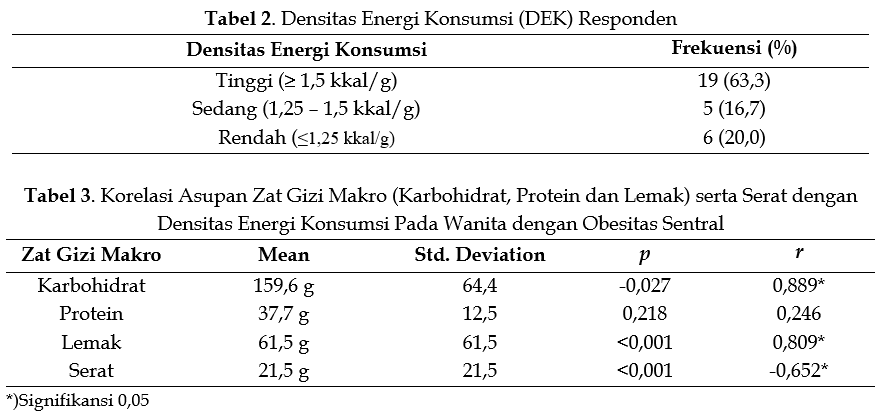
Central obesity is a health problem associated with an increased risk of cardiometabolic diseases, particularly among women. One factor that plays a role in weight management and obesity is dietary energy density, defined as the amount of energy contained in each gram of food or beverage consumed. This study aimed to analyze the association between dietary energy density and the intake of macronutrients and fiber among women with central obesity in a fitness community. This study was an observational study with a cross-sectional design involving 30 women aged 19–50 years who were members of the Lampung Workout Community, had a waist circumference of ≥80 cm, and had no history of certain serious diseases. Carbohydrate, protein, fat, and fiber intake was collected using two 24-hour food recalls on one weekday and one weekend day, and then analyzed using NutriSurvey. Dietary energy density was calculated by dividing total energy intake by the total weight of foods and beverages consumed. Bivariate analysis was performed using Pearson’s correlation test with a significance level of p < 0.05. The results showed that most respondents had high dietary energy density, accounting for 63.3%. Carbohydrate, fat, and fiber intake were significantly associated with dietary energy density, whereas protein intake showed no significant association. Fat intake was positively associated with dietary energy density, while fiber intake was negatively associated. These findings indicate that regulating the consumption of low-energy-density, high-fiber, and low-fat foods may serve as a strategy for the prevention and management of central obesity among women.
Downloads
References
Alves, I. A., Jessri, M., Monteiro, L. S., Gomes, L. E. D. S., Lopes, T. D. S., Yokoo, E. M., Sichieri, R., & Pereira, R. A. (2024). Energy-Dense and Low-Fiber Dietary Pattern May Be a Key Contributor to the Rising Obesity Rates in Brazil. International Journal of Environmental Research and Public Health, 21(8), 1038. https://doi.org/10.3390/ijerph21081038
American Diabetes Association Professional Practice Committee. (2024). 8. Obesity and weight management for the prevention and treatment of type 2 diabetes: Standards of Care in Diabetes 2024. Diabetes Care, 47(Supplement 1), S145–S157. https://doi.org/10.2337/dc24-S008
Annisa, P. A., & Tanziha, I. (2014). Densitas Energi Konsumsi, Status Gizi dan Daya Ingat Sesaat Anak Usia Sekolah Dasar. Jurnal Gizi dan Pangan, 9(3), 187–194. https://doi.org/10.25182/jgp.2014.9.3.
Caterson I. D. (2009). Medical management of obesity and its complications. Annals of the Academy of Medicine, Singapore, 38(1), 22–28.
Dewi, U. P., & Dieny, F. F. (2013). Hubungan Antara Densitas Energi dan Kualitas Diet dengan Indeks Massa Tubuh (IMT) Pada Remaja. Journal of Nutrition College, 2(4), 447–457. https://doi.org/doi.org/10.14710/jnc.v2i4.3726
Du, H., van der A, D. L., Boshuizen, H. C., Forouhi, N. G., Wareham, N. J., Halkjær, J., Tjønneland, A., Overvad, K., Jakobsen, M. U., Boeing, H., Buijsse, B., Masala, G., Palli, D., Sørensen, T. I. A., & Feskens, E. J. M. (2010). Dietary energy density in relation to subsequent changes of weight and waist circumference in European men and women. PLOS ONE, 5(4), e10310. https://doi.org/10.1371/journal.pone.0010310
Erdoğan, O., Erdoğan, T., Önür, N. H., Özkök, S., Karan, M. A., & Bahat, G. (2025). Beyond BMI: central obesity measures and Cardiovascular Risk in Late Life. Aging Clinical and Experimental Research, 37(287). https://doi.org/10.1007/s40520-025-03197-z
Gibson, R. S. (2005). Principles of Nutrition Assessment (2nd ed). Oxford University Press, Inc.
Kementerian Kesehatan Republik Indonesia. (2019). Peraturan Menteri Kesehatan Republik Indonesia Nomor 28 Tahun 2019 tentang angka kecukupan gizi yang dianjurkan untuk masyarakat Indonesia. Kementerian Kesehatan Republik Indonesia.
Kementerian Kesehatan Republik Indonesia. (2023). Survei Kesehatan Indonesia (SKI) Dalam Angka. Dalam Badan Kebijakan Pembangunan Kesehatan.
Ong, R. H. S., Chow, W. L., Cheong, M., Lim, G. H., Xie, W., Baggs, G., Huynh, D. T. T., Oh, H. C., How, C. H., Tan, N. C., Tey, S. L., & Chew, S. T. H. (2021). Associations between socio-demographics, nutrition knowledge, nutrition competencies and attitudes in community-dwelling healthy older adults in Singapore: findings from the SHIELD study. J Health Popul Nutr, 40, 52. https://doi.org/10.1186/s41043-021-00277-4
Rolls, B. J. (2009). The relationship between dietary energy density and energy intake. Physiology & behavior, 97(5), 609–615. https://doi.org/10.1016/j.physbeh.2009.03.011
Rolls, B. J. (2017a). Dietary energy density: applying behavioural science to weight management. Nutrition bulletin, 42(3), 246–253. https://doi.org/10.1111/nbu.12280
Rolls, B. J. (2017b). Dietary energy density: applying behavioural science to weight management. Nutrition bulletin, 42(3), 246–253. https://doi.org/10.1111/nbu.12280
Safitri, D. E., Fitri, Z. E., & Lestari, W. A. (2021). Densitas Energi Konsumsi dan Densitas Asupan Protein Berhubungan dengan Status Gizi Anak Usia Sekolah. Muhammadiyah Journal of Nutrition and Food Science (MJNF), 2(2), 95–102. https://doi.org/10.24853/mjnf.2.2.95-102
Sirajuddin, S., Surmita, S., & Astuti, T. (2018). Bahan ajar gizi: Survey konsumsi pangan. Kementerian Kesehatan Republik Indonesia.
Downloads
Published
How to Cite
Issue
Section
License
Copyright (c) 2026 Anggun Rusyantia, Endang Sri Wahyuni, Sutrio

This work is licensed under a Creative Commons Attribution-ShareAlike 4.0 International License.