Effectiveness of Rain Sound Music as a Relaxation Stimulus on Parasympathetic Nervous System Activity Based on Heart Rate and REM Sleep Stage
DOI:
https://doi.org/10.58184/miki.v4i3.1063Keywords:
stress, heart rate, REM sleep phase, rain sound music, digital smartwatchAbstract
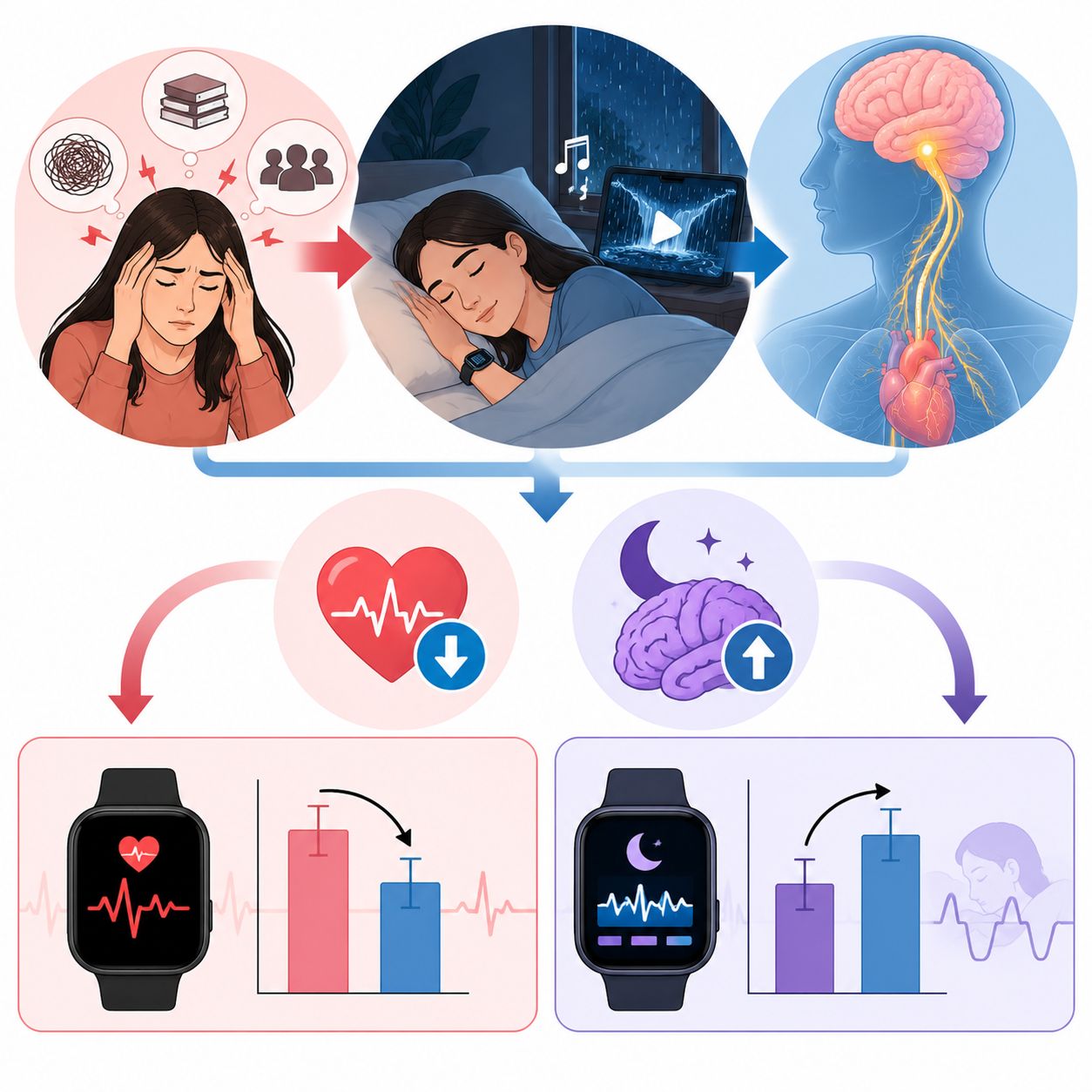
Stress may arise due to internal and external stressors. Persistent stress can induce psychological pressure and may progress to a state of mental exhaustion (burnout). In addition, stress can contribute to sleep disturbances, potentially exacerbating anxiety and depression, thereby creating a continuous cycle. This study aimed to analyze parasympathetic nervous system activation through the vagal system based on changes in heart rate and the stability of the REM sleep phase during exposure to rain sound music while sleeping. This study employed a quantitative approach with a quasi-experimental design using a one-group pretest-posttest design involving 20 research subjects. The intervention consisted of exposure to rain sound music delivered through the YouTube platform, while heart rate and REM sleep phase measurements were obtained using a digital smartwatch. The study was conducted over eight days, consisting of four days without rain sound music intervention and four days with rain sound music intervention. The paired t-test revealed a significant decrease in mean heart rate from 57.50 ± 7.85 bpm to 54.95 ± 7.76 bpm (p = 0.009), while the Wilcoxon signed-rank test indicated a significant increase in the mean REM sleep duration from 64.40 ± 23.72 min to 72.55 ± 22.97 min (p = 0.040). These findings indicate that rain sound music intervention may provide a relaxation effect through enhanced parasympathetic activity, characterized by reduced heart rate and increased REM sleep duration. Future studies are recommended to incorporate Heart Rate Variability (HRV) measurements and electrocardiography (ECG)-based smartwatch features to obtain a more comprehensive assessment of autonomic nervous system activity.
Downloads
References
Brown, R. E., Spratt, T. J., & Kaplan, G. B. (2022). Translational approaches to influence sleep and arousal. Brain Research Bulletin, 185, 140–161. https://doi.org/10.1016/j.brainresbull.2022.05.002
Concheiro-Moscoso, P., Groba, B., Alvarez-Estevez, D., Miranda-Duro, M. C., Pousada, T., Nieto-Riveiro, L., Mejuto-Muiño, F. J., & Pereira, J. (2023). Quality of sleep data validation from the Xiaomi Mi Band 5 against polysomnography: Comparison study. Journal of Medical Internet Research, 25, e42073. https://doi.org/10.2196/42073
Cordi, M. J., Schlarb, A. A., & Rasch, B. (2019). Effects of relaxing music on healthy sleep. Scientific Reports, 9, 9079. https://doi.org/10.1038/s41598-019-45608-y
Esfahani, M. J., Farboud, S., Ngo, H. V. V., Schneider, J., Weber, F. D., Talamini, L. M., & Dresler, M. (2023). Closed-loop auditory stimulation of sleep slow oscillations: Basic principles and best practices. Neuroscience and Biobehavioral Reviews, 153, Article 105379. https://doi.org/10.1016/j.neubiorev.2023.105379
Fan, L., & Baharum, M. R. (2024). The effect of exposure to natural sounds on stress reduction: A systematic review and meta-analysis. Stress and Health, 40(6), e2402519. https://doi.org/10.1080/10253890.2024.2402519
Harahap, S. S. M., Nasution, W., & Siregar, F. S. (2024). Hubungan Tingkat Stress dengan Kualitas Tidur pada Mahasiswa Akhir Fakultas Kesehatan Masyarakat di Universitas Islam Negeri Sumatera Utara Medan. Journal of Health and Religion, 1(2), 45–52.
Jo, H., Song, C., Ikei, H., Enomoto, S., Kobayashi, H., & Miyazaki, Y. (2019). Physiological and psychological effects of forest and urban sounds using high-resolution sound sources. International Journal of Environmental Research and Public Health, 16(15), 2649. https://doi.org/10.3390/ijerph16152649
Kuula, L., Halonen, R., Kajanto, K., Lipsanen, J., Makkonen, T., Peltonen, M., & Pesonen, A.-K. (2020). The effects of presleep slow breathing and music listening on polysomnographic sleep measures: A pilot trial. Scientific Reports, 10, Article 7427. https://doi.org/10.1038/s41598-020-64218-7
Lemeshow, S., Hosmer, D. W., Klar, J., & Lwanga, S. K. (1990). Adequacy of sample size in health studies. John Wiley & Sons.
Leśniewska, A., Górska-Klimowska, U., Wyczesany, M., Hołda, M., Chojnacki, B., & Binder, M. (2026). Sleep stages affect low-gamma range effective cortical connectivity for 40-Hz auditory steady-state responses. Biological Psychology, 206, Article 109243. https://doi.org/10.1016/j.biopsycho.2026.109243
Liu, P.-K., Ting, N., Chiu, H.-C., Lin, Y.-C., Liu, Y.-T., Ku, B., & Lee, P.-L. (2023). Validation of photoplethysmography- and acceleration-based sleep staging in a community sample: Comparison with polysomnography and Actiwatch. Journal of Clinical Sleep Medicine, 19(10), 1797–1810. https://doi.org/10.5664/jcsm.10690
Meza, C., Juega, J., Francisco, J., Santos, A., Duran, L., Rodriguez, M., Alvarez-Sabin, J., Sero, L., Ustrell, X., Bashir, S., Serena, J., Silva, Y., Molina, C., & Pagola, J. (2023). Accuracy of a smartwatch to assess heart rate monitoring and atrial fibrillation in stroke patients. Sensors, 23(10), 4632. https://doi.org/10.3390/s23104632
Song, I., Baek, K., Kim, C., & Song, C. (2023). Effects of nature sounds on the attention and physiological and psychological relaxation. Urban Forestry & Urban Greening, 86, 127987. https://doi.org/10.1016/j.ufug.2023.127987
Vieira, L., Carvalho, C., Grilo, A., Reis, J., Pires, A. F., Pereira, E., Carolino, E., & Almeida-Silva, M. (2024). Effects of a music-based intervention on psychophysiological outcomes of patients undergoing medical imaging procedures: A systematic review and meta-analysis. Radiography, 30(2), 589–604. https://doi.org/10.1016/j.radi.2024.01.014
Wang, C., Li, G., Zheng, L., Meng, X., Meng, Q., & Wang, S. (2021). Effects of music intervention on sleep quality of older adults: A systematic review and meta-analysis. Complementary Therapies in Medicine, 59, 102719. https://doi.org/10.1016/j.ctim.2021.102719
Downloads
Published
How to Cite
Issue
Section
License
Copyright (c) 2026 Maulidina Putri Kamilani, Tri Wahyuliati

This work is licensed under a Creative Commons Attribution-ShareAlike 4.0 International License.