Initial Implementation of a Single-Visit School-Based Anemia Screening Pathway (PHTC) among Elementary School Children in Samarinda
DOI:
https://doi.org/10.58184/miki.v4i3.1095Keywords:
anemia, hemoglobin, point-of-care testing, school health, screeningAbstract
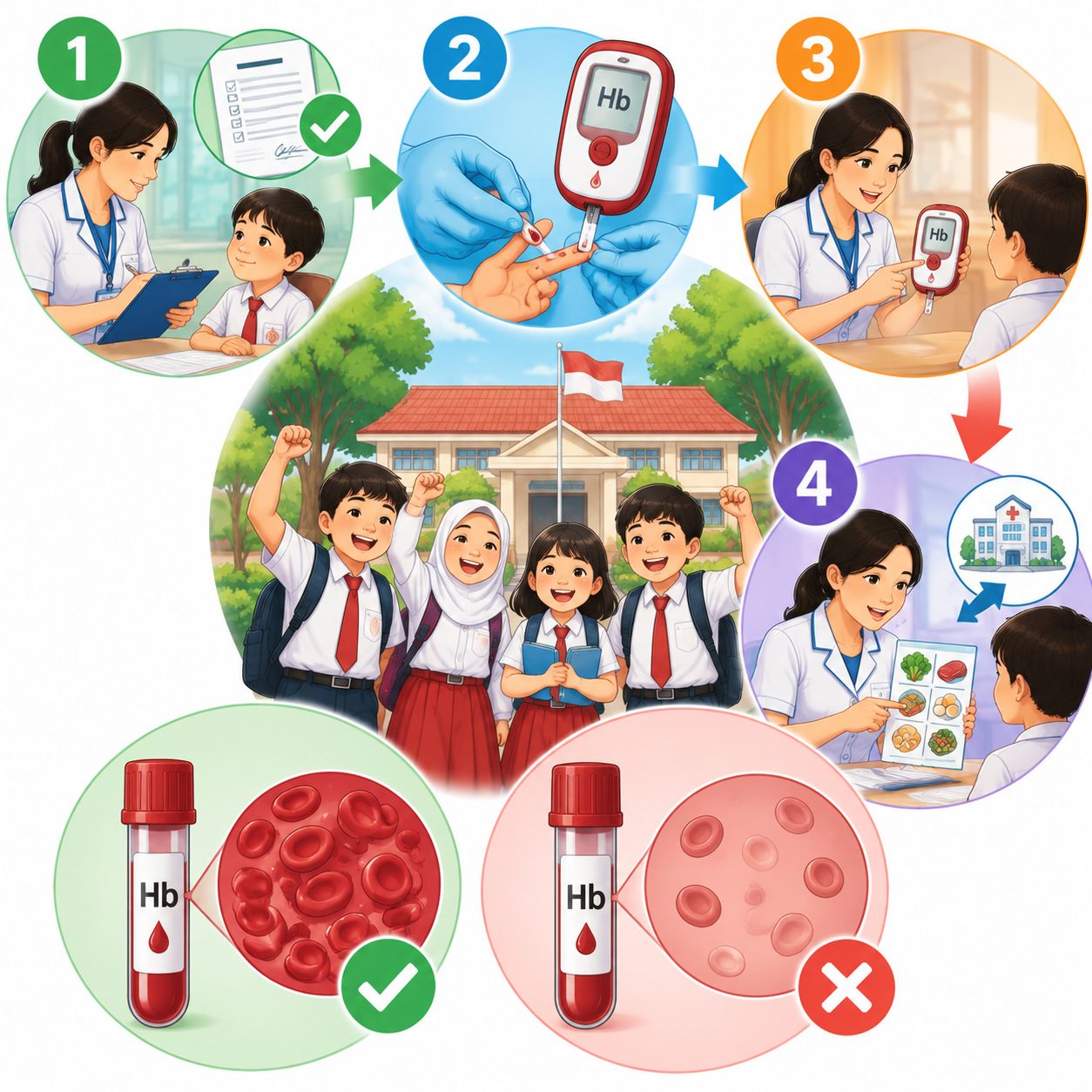
Anemia remains an important nutritional health problem among school-aged children and may be difficult to detect when symptoms are nonspecific. This study aimed to describe the initial implementation of a school-based anemia screening pathway through the Rapid Best Outcome Program (Program Hasil Terbaik Cepat [PHTC]) during a single visit and to describe hemoglobin (Hb) findings among participants. A descriptive cross-sectional study was conducted involving 25 elementary school students aged 7–12 years in Samarinda City. The PHTC pathway consisted of four operational stages documented in the study protocol: eligibility verification and consent, capillary Hb measurement using point-of-care testing, same-session delivery of Hb results, and brief education with recommendations for further examination when Hb levels were below age-specific thresholds. Anemia status was classified according to World Health Organization criteria, namely Hb <11.5 g/dL for children aged 5–11 years and Hb <12.0 g/dL for those aged 12–14 years. The mean Hb level among participants was 11.71 ± 0.92 g/dL, with values ranging from 9.5 to 13.3 g/dL. A total of 8 out of 25 participants (32.0%; 95% CI: 17.2%–51.6%) were classified as having anemia. All participants completed the four implementation stages, received Hb examination results, and obtained education during the same school session. All participants with Hb levels below the age-specific cut-off values received recommendations for further examination. Implementation time was not prospectively measured using a standardized time-recording protocol and was therefore not analyzed as a formal outcome. These findings describe the completion of implementation stages and coverage under a single-site study condition rather than demonstrating effectiveness, comparative efficiency, or generalizable feasibility.
Downloads
References
Ashar, H., Mulyantoro, D. K., Nurcahyani, Y. D., & Khaerunnisa, M. (2016). Anemia pada Anak Sekolah Dasar di Daerah Endemik GAKI. Media Gizi Mikro Indonesia, 7(2), 91–98. https://doi.org/10.22435/mgmi.v7i2.6015.91-98
Badan Kebijakan Pembangunan Kesehatan. (2023). Survei Kesehatan Indonesia (SKI) 2023 dalam angka. Kementerian Kesehatan Republik Indonesia. Badan Kebijakan Pembangunan Kesehatan (BKPK). https://www.badankebijakan.kemkes.go.id/ski-2023-dalam-angka
Badan Penelitian dan Pengembangan Kesehatan. (2019). Laporan nasional Riset Kesehatan Dasar (Riskesdas) 2018. Lembaga Penerbit Badan Penelitian dan Pengembangan Kesehatan. Badan Penelitian dan Pengembangan Kesehatan (Balitbangkes). https://www.badankebijakan.kemkes.go.id/repositori/id/eprint/3514
Banerjee, M., Bhatti, V. K., Roy, D., & Tomo, S. (2022). A national survey of the prevalence of anemia and obesity in Indian school children. Journal of Community Hospital Internal Medicine Perspectives, 12(5), 48–53. https://doi.org/10.55729/2000-9666.1110
Fu, Q., Qi, T., Wu, Z., He, Y., Guan, S., Luo, S., Zhang, Q., Luo, W., Xiao, W., Situ, B., & Zheng, L. (2022). A portable smartphone-based hemoglobin point-of-care testing platform for accurate anemia diagnostics. Biosensors and Bioelectronics, 217, 114711. https://doi.org/10.1016/j.bios.2022.114711
Gutema, B. T., Sorrie, M. B., Megersa, N. D., Yesera, G. E., Yeshitila, Y. G., Pauwels, N. S., De Henauw, S., & Abbeddou, S. (2023). Effects of iron supplementation on cognitive development in school-age children: Systematic review and meta-analysis. PLOS ONE, 18(6), e0287703. https://doi.org/10.1371/journal.pone.0287703
Habtegiorgis, S. D., Petrucka, P., Telayneh, A. T., Getahun, D. S., Getacher, L., Alemu, S., & Birhanu, M. Y. (2022). Prevalence and associated factors of anemia among adolescent girls in Ethiopia: A systematic review and meta-analysis. PLOS ONE, 17(3), e0264063. https://doi.org/10.1371/journal.pone.0264063
Haidir, I. Y., Fattah, N., & Raudhani, N. (2021). Pelatihan Deteksi, Tatalaksana, Pencegahan Anemia Anak Usia Sekolah di Madrasah Ibtidaiyah Fatthur Rahman Makassar. Jurnal Pengabdian Kedokteran Indonesia, 2(1), 9–14. https://doi.org/10.33096/jpki.v2i1.124
Li, S., Cheng, X., Zhao, L., & Ren, H. (2021). Anemia of school-age children in primary schools in Southern China should be paid more attention despite the significant improvement at national level: Based on Chinese Nutrition and Health Surveillance data (2016–2017). Nutrients, 13(11), 3705. https://doi.org/10.3390/nu13113705
Lubis, D. R., & Angraeni, L. (2022). Deteksi Dini Anemia melalui Pemeriksaan Kadar Hemoglobin pada Remaja Puteri. Jurnal Pengabdian Masyarakat Bakti Parahita, 3(1), 24–33. https://doi.org/10.54771/jpmbp.v3i01.377
Marsudi, L. O., Utami, R. A., & Aminuddin, M. F. (2024). Skrining dan Edukasi Kesehatan tentang Peran Hemoglobin terhadap Pertumbuhan dan Perkembangan Kecerdasan Remaja pada Siswa SMK Kesehatan Samarinda. Jurnal Pengabdian Masyarakat Teknologi Laboratorium Medik Borneo, 4(2), 30–37. https://doi.org/10.35728/abdmlt.v4i2.1705
Méndez-Gómez-Humarán, I., De la Cruz-Góngora, V., Dary, O., & Shamah-Levy, T. (2024). Capillary drops, capillary pooled, and venous blood samples for determining hemoglobin concentration using HemoCue: A measurement system analysis. PLOS ONE, 19(10), e0312233. https://doi.org/10.1371/journal.pone.0312233
Monárrez-Espino, J., & Roos, N. (2008). Comparison of the analytic performance between the B-Hb and Hb-201+ HemoCue® hemoglobinometers for venous and capillary blood under field work conditions. Ecology of Food and Nutrition, 47(2), 159–169. https://doi.org/10.1080/03670240701702982
Nidianti, E., Nugraha, G., Aulia, I. A. N., Syadzila, S. K., Suciati, S. S., & Utami, N. D. (2019). Pemeriksaan Kadar Hemoglobin dengan Metode POCT (Point of Care Testing) sebagai Deteksi Dini Penyakit Anemia bagi Masyarakat Desa Sumbersono, Mojokerto. Jurnal Surya Masyarakat, 2(1), 29–34. https://doi.org/10.26714/jsm.2.1.2019.29-34
Panda, P. K., Sharawat, I. K., Pradhan, P., Malik, V. S., & Singh, M. (2025). Diagnostic accuracy of point-of-care devices for detection of anemia in children in community settings: A systematic review and meta-analysis. European Journal of Pediatrics, 184(1), 23. https://doi.org/10.1007/s00431-024-05875-y
Purwandari, A., Anisah, N., & Damayanti, S. (2025). Deteksi Dini Anemia dan Edukasi Gizi pada Anak Usia Sekolah di SD Muhammadiyah Karangbendo. DIMAS: Jurnal Pengabdian Masyarakat, 8(2), 18–20. https://doi.org/10.47317/dmk.v8i2.747
Samson, K. L. I., Fischer, J. A. J., & Roche, M. L. (2022). Iron status, anemia, and iron interventions and their associations with cognitive and academic performance in adolescents: A systematic review. Nutrients, 14(1), 224. https://doi.org/10.3390/nu14010224
Sirajuddin, S., & Masni, M. (2015). Kejadian Anemia pada Siswa Sekolah Dasar. Kesmas: National Public Health Journal, 9(3), 264–269. https://doi.org/10.21109/kesmas.v9i3.574
Von Elm, E., Altman, D. G., Egger, M., Pocock, S. J., Gøtzsche, P. C., & Vandenbroucke, J. P. (2007). The Strengthening the Reporting of Observational Studies in Epidemiology (STROBE) Statement: Guidelines for Reporting Observational Studies. PLOS Medicine, 4(10), e296. https://doi.org/10.1371/journal.pmed.0040296
World Health Organization. (2024). Guideline on haemoglobin cutoffs to define anaemia in individuals and populations. World Health Organization (WHO). https://www.who.int/publications/i/item/9789240088542
Downloads
Published
How to Cite
Issue
Section
License
Copyright (c) 2026 Evy Nurachma, Rahayu Arum Winarningsih, Irma Rosliani Dewi, Mimin Kusmiyati

This work is licensed under a Creative Commons Attribution-ShareAlike 4.0 International License.