Analysis of Vitamin C in Sambal Orange and Passion Fruit Syrup Using Iodometric Titration Method
DOI:
https://doi.org/10.58184/miki.v4i1.871Abstract
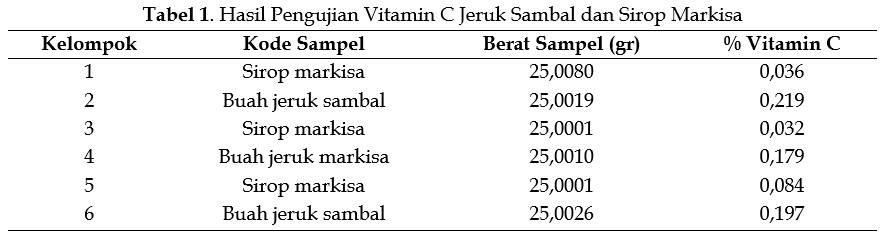
Vitamin C, or ascorbic acid, is a water-soluble vitamin with acidic properties and strong reducing capabilities. The content of vitamin C plays a role in protecting cells and molecules such as proteins, lipids, and nucleic acids, and it serves as an antioxidant that can neutralize free radicals in the body. The aim of this study was to identify the vitamin C content in fresh fruit such as sambal oranges and processed fruit such as passion fruit syrup, as well as to understand the stages involved in vitamin C testing. The testing was conducted using the iodometric titration method with a quantitative approach. The results showed that the vitamin C content in sambal oranges ranged from 0.179% to 0.219%, which was higher compared to passion fruit syrup, which had values ranging from 0.032% to 0.084%. These differences could be attributed to variations in the vitamin content of the fruits, their physical and chemical properties, and the technical aspects of the sample testing. Based on these results, sambal oranges and passion fruit syrup have the potential to serve as good sources of vitamin C, whether consumed directly or processed.
Downloads
References
Anadwi, R. S. (2024). Penentuan Kadar Vitamin C dari Produk Sirup Markisa secara Spektrofotometri Visibel dan Uji Aktivitas Antioksidan dengan Metode DPPH (Skripsi, Universitas Sumatera Utara). Repositori Institusi Universitas Sumatera Utara. https://repositori.usu.ac.id/handle/123456789/108688
Badriyah, L., & Manggara, A. B. (2015). Penetapan Kadar Vitamin C pada Cabai Merah (Capsicum annum L.) menggunakan Metode Spektrofotometri UV-VIS. Jurnal Wiyata: Penelitian Sains dan Kesehatan, 2(1), 25–28. https://doi.org/10.56710/wiyata.v2i1.31
Badan Pengawas Obat dan Makanan. (2016). Peraturan Kepala Badan Pengawas Obat dan Makanan Nomor 9 Tahun 2016 tentang Acuan Label Gizi. Badan Pengawas Obat dan Makanan (BPOM). Jakarta.
Fitriana, Y. A. N., & Fitri, A. S. (2020). Analisis Kadar Vitamin C pada Buah Jeruk Menggunakan Metode Titrasi Iodometri. Sainteks, 17(1), 27–32. https://doi.org/10.30595/sainteks.v17i1.8530
Humaira, S. F., Dewi, Y. S. K., & Hartanti, L. (2022). Penggunaan Jeruk Sambal (Citrus amblycarpa) sebagai Bahan Pengasam Alami Terhadap Sifat Fisikokimia dan Sensori Mayones. FoodTech: Jurnal Teknologi Pangan, 4(1), 24–31. https://doi.org/10.26418/jft.v4i1.56638
Lulu., Anastasia, D. S., & Yuswar, M. A. (2022). Review: Penggunaan Vitamin C pada Sediaan Kosmetik. Jurnal Cerebellum, 8(3), 30–34
Mulyani, E. (2018). Perbandingan hasil penetapan kadar vitamin C pada buah kiwi (Actinidia deliciousa) dengan menggunakan metode iodimetri dan spektrofotometri UV-Vis. Jurnal Farmasi, Sains, dan Kesehatan, 3(2), 14–17.
Putri, M. P., & Setiawati, Y. H. (2015). Analisis Kadar Vitamin C pada Buah Nanas Segar (Ananas comosus (L.) Merr) dan Buah Nanas Kaleng dengan Metode Spektrofotometri UV-Vis. Jurnal Wiyata: Penelitian Sains dan Kesehatan, 2(1), 34–38. https://doi.org/10.56710/wiyata.v2i1.33
Rahayuningsih, J., Sisca, V., & Eliyarti, E. (2022). Analisis Vitamin C pada Buah Jeruk Pasaman untuk Meningkatkan Imunitas Tubuh pada Masa Pandemi: Analisis Vitamin C. Journal of Research and Education Chemistry, 4(1), 29–33. https://doi.org/10.25299/jrec.2022.vol4(1).9363
Sari, M. P., & Daulay, A. S. (2022). Penentuan Kadar Vitamin C pada Minuman Bervitamin pada Berbagai Suhu Penyimpanan dengan Metode Spektrofotometri UV. Journal of health and Medical Science, 1(2), 116–124.
Downloads
Published
How to Cite
Issue
Section
License
Copyright (c) 2026 Lusiana, Nur Fitria Andani, Risky, Ilma Munaya, Muhammad Azman

This work is licensed under a Creative Commons Attribution-ShareAlike 4.0 International License.