Comparison of Proximate Composition of Tuna and Mackerel Protein Hydrolysates for Diet Development in Non-Communicable Disease
DOI:
https://doi.org/10.58184/miki.v4i2.951Keywords:
fish protein hydrolysate, tuna, mackerel, diet, non-communicable diseasesAbstract
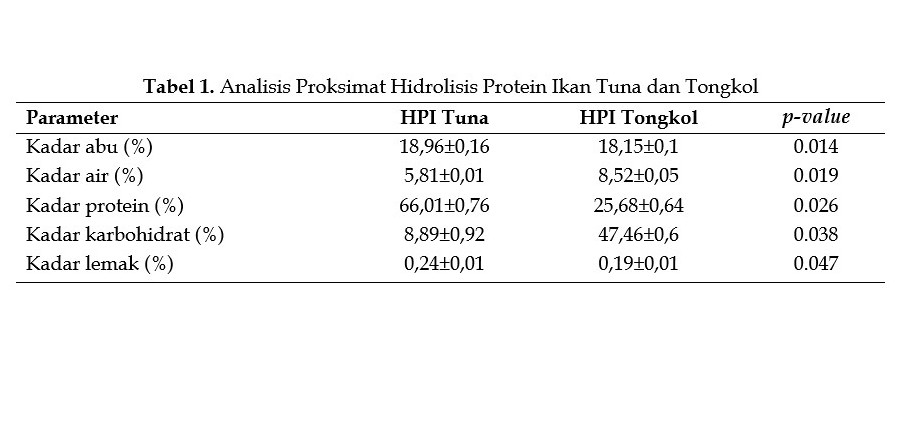
Non-communicable diseases (NCDs) remain the leading causes of death worldwide and are closely associated with unhealthy dietary patterns. This condition highlights the need for comprehensive interventions, including dietary approaches. One strategy to reduce the severity of NCDs is the development of food innovations that can improve diet quality, particularly in terms of palatability, without increasing disease risk. Fish protein hydrolysate (FPH) contains amino acids such as glutamate, which contributes to umami taste and can be utilized as a flavor enhancer to improve food acceptability. This study aimed to compare the proximate composition of FPH derived from tuna (Thunnus sp.) and kawakawa (Euthynnus affinis) as a basis for developing flavor enhancers for NCD dietary management. This study used a laboratory experimental design with a quantitative descriptive approach. FPH was produced through enzymatic hydrolysis using papain, followed by proximate analysis including ash, moisture, carbohydrate, protein, and fat contents. The results showed that protein content was higher in tuna FPH, whereas its moisture content was lower than that of kawakawa FPH. Both samples had low fat and ash contents. All parameters differed significantly between samples (p < 0.05), including ash content (p = 0.014), moisture content (p = 0.019), protein content (p = 0.026), carbohydrate content (p = 0.038), and fat content (p = 0.047). Overall, tuna FPH showed better nutritional characteristics and has potential as a natural flavor enhancer to support dietary management in NCDs.
Downloads
References
Badan Standardisasi Nasional. (1992). SNI 01-2891-1992 Cara Uji Makanan dan Minuman. Badan Standardisasi Nasional.
Chalamaiah, M., Dinesh Kumar, B., Hemalatha, R., & Jyothirmayi, T. (2012). Fish protein hydrolysates: Proximate composition, amino acid composition, antioxidant activities and applications: A review. Food Chemistry, 135(4), 3020–3038. https://doi.org/10.1016/j.foodchem.2012.06.100
Dana, E. B., Jinoy, V. G., & Saleena, M. (2019). Nutritional evaluation of fish protein hydrolysate from tuna, Thunnus albacares (Bonnaterre, 1788). Int J. Life Sci Res, 7(3), 11–17.
Direktorat Jenderal Kesehatan. (2024). Mengenal Diet Rendah Garam. Kemenkes Direktorat Jenderal Kesehatan.
Halim, J., Bouzari, A., Felder, D., & Guinard, J. X. (2020). The Salt Flip: Sensory mitigation of salt (and sodium) reduction with monosodium glutamate (MSG) in “Better-for-You” foods. Journal of Food Science, 85(9), 2902–2914. https://doi.org/10.1111/1750-3841.15354
Horwitz, W., & Latimer, G. W. (2005) Official Methods of Analysis of AOAC International. 18th Edition, Association of Official Analytical Chemistry International; Maryland.
Iduantoro, C. P., Zuraida, I., Sulistiawati, S., Mismawati, A., & Pamungkas, B. F. (2024). Potensi Peptida Bioaktif dari Hasil Samping Perikanan sebagai Antihipertensi dan Antioksidan–Review. Media Teknologi Hasil Perikanan, 12(1), 19–26. https://doi.org/10.35800/mthp.12.1.2024.52202
Islam, M. S., Hongxin, W., Admassu, H., Noman, A., Ma, C., & An Wei, F. (2021). Degree of hydrolysis, functional and antioxidant properties of protein hydrolysates from Grass Turtle (Chinemys reevesii) as influenced by enzymatic hydrolysis conditions. Food Science & Nutrition, 9(8), 4031–4047. https://doi.org/10.1002/fsn3.1903
Kementerian Kesehatan Republik Indonesia. (2023a). Hasil Survei Status Gizi Indonesia (SSGI) 2022.
Kementerian Kesehatan Republik Indonesia. (2023b). Survei Kesehatan Indonesia (SKI) 2023 dalam Angka.
Nakamura, H., Kawashima, T., Yamasaki, L., Lwin, K. S., Eguchi, A., Hayabuchi, H., Tanoe, Y., Tanaka, S., Yoneoka, D., Ghaznavi, C., Uneyama, H., Shibuya, K., & Nomura, S. (2022). Reducing salt intake with umami: A secondary analysis of data in the UK National Diet and Nutrition Survey. Food Science & Nutrition, 11(2), 872–882. https://doi.org/10.1002/fsn3.3121
Nomura, S., Ishizuka, A., Tanaka, S., Yoneoka, D., Uneyama, H., & Shibuya, K. (2021). Umami: An Alternative Japanese Approach to Reducing Sodium While Enhancing Taste Desirability. Health, 13(06), 629–636. https://doi.org/10.4236/health.2021.136047
Normah, I., & Diyana, N. (2018). Evaluation of umaminess in green mussel hydrolysate (Perna viridis) produced in the presence of sodium tripolyphosphate and NaCl. International Food Research Journal, 25(6), 2524–2530.
Prasetyo, D. Y. B., Agustini, T. W., Anjani, G., & Riyadi, P. H. (2025). Evaluation of Immunomodulatory Properties of Fish-Protein Hydrolysate from Skipjack Tuna by-products (Katsuwonus pelamis, Linnaeus 1758) in Streptozotocin-Nicotinamide-Induced Diabetic Rats. World’s Veterinary Journal, 15(1), 117–125. https://doi.org/10.54203/scil.2025.wvj14
Rachman, S. H., Santoso, J., & Suseno, S. H. (2023). Antioxidant Activity and Potential Bioactive Peptides from Skin Protein Hydrolysate of Yellowfin Tuna (Thunnus albacares). Jurnal Ilmiah Perikanan Dan Kelautan, 15(2), 248–263. https://doi.org/10.20473/jipk.v15i2.41625
Rachmawati, S. N., Antika, R. B., Rohmawati, N., & Hermilasari, R. D. (2025). The formulation of edamame flour and tuna fish protein hydrolyzate biscuit as an alternative supplementary feeding for stunting. Jurnal Gizi Dan Dietetik Indonesia (Indonesian Journal of Nutrition and Dietetics), 13(1), 1–9. https://doi.org/10.21927/ijnd.2025.13(1).1-9
Ruhana, A., & Afifah, C. A. N. (2020). Sugar and Cooking Oil Consumption in Surabaya. International Joint Conference on Science and Engineering (IJCSE 2020), 273–276. https://doi.org/10.2991/aer.k.201124.049
Salman. S., Firawati. F., Setiawan, D., Nuradi, N., Muzayyidah, M., Usman, S., Sari, R. P., Kumiaty, L., Ardiani, R., Firsty, G. R., Deniyati, D., Ramadhani, F. N., Krisnawati, M., Hasanah, N., Abdullah, R., & Angganawati, R. T. (2024). Farmakokinetika (Ruslin & A. Jabbar (eds.); 1st ed.). Eureka Media Aksara.
Song, C., Yang, Y. E., Zhao, Z., Tan, M., Chen, Z., Zheng, H., Gao, J., Lin, H., Zhu, G., & Cao, W. (2024). Insight into the correlation of taste substances and salty-umami taste from Monetaria moneta hydrolysates prepared using different proteases. Food Chemistry: X, 24, 102056. https://doi.org/10.1016/j.fochx.2024.102056
World Health Organization. (2025). Noncommunicable diseases progress monitor 2025. World Health Organization. https://www.who.int/publications/i/item/9789240105775
Winarno, F. G. (2008). Kimia Pangan dan Gizi. PT Gramedia Pustaka Utama; Yogyakarta.
Witono, Y., Maryanto, M., Taruna, I., Masahid, A. D., & Cahyaningati, K. (2020). Aktivitas Antioksidan Hidrolisat Protein Ikan Wader (Rasbora Jacobsoni) dari Hidrolisis oleh Enzim Calotropin dan Papain. Jurnal Agroteknologi, 14(01), 44–57.
Yuliardi, A. (2024). Strategi Kolaboratif Sektor Kesehatan dengan Industri Makanan Minuman untuk Menurunkan Risiko Hipertensi dan Diabetes di Indonesia (Policy Brief Sibijaks Awards 2024). https://repository.badankebijakan.kemkes.go.id/id/eprint/5945/
Downloads
Published
How to Cite
Issue
Section
License
Copyright (c) 2026 Septi Nur Rachmawati, Baiq Dewi Sukma Septiani

This work is licensed under a Creative Commons Attribution-ShareAlike 4.0 International License.