Effect of Distance to Health Care Facilities on Treatment Adherence in Tuberculosis Patients: A Meta-Analysis
DOI:
https://doi.org/10.58184/miki.v4i2.957Keywords:
Tuberculosis, treatment compliance, distance traveled, health service facilitiesAbstract
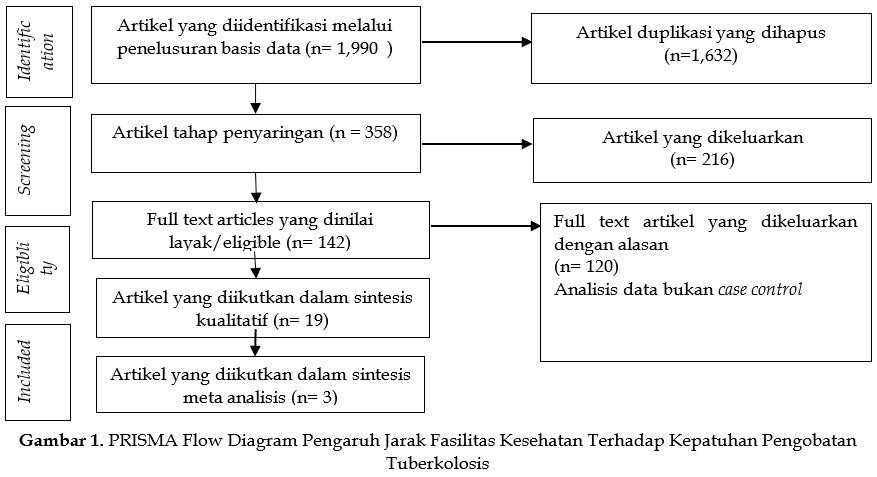
Patient adherence to tuberculosis (TB) treatment is an essential factor in ensuring therapeutic success, preventing relapse, and mitigating the rate of drug resistance in the community. One structural barrier frequently associated with suboptimal adherence levels is the geographical distance between the patient's residence and healthcare facilities. Given that previous literature still exhibits variations in empirical findings, this study aims to quantitatively synthesize and estimate the magnitude of the effect of healthcare facility distance on the treatment adherence of TB patients. This systematic review and meta-analysis was designed in adherence to the standard Preferred Reporting Items for Systematic Reviews and Meta-Analyses (PRISMA) guidelines. The literature search strategy focused on the Google Scholar database by establishing inclusion criteria based on the PICO framework: TB patients (Population), easily accessible healthcare facilities (Exposure), inaccessible healthcare facilities (Comparator), and the level of treatment adherence (Outcome). Statistical synthesis was executed using Review Manager 5.3 software. The eligibility evaluation identified three case-control primary studies included in the analysis. The forest plot visualization confirmed that patients facing inaccessible healthcare facilities possess a significantly higher probability of non-adherence by 3.76 times compared to patients with easy access (aOR = 3.76; 95% CI = 2.11–6.70; p = 0.0001). Although the statistical test demonstrated perfect methodological homogeneity across the studies (I² = 0%), an indication of potential publication bias was detected through the funnel plot visualization. In conclusion, geographical distance barriers are proven to significantly degrade TB treatment adherence. Proactive policy interventions, such as service decentralization and community-based medical governance innovations, are highly crucial to overcome these spatial obstacles.
Downloads
References
Aqsyari, R., Sumardiyono, S., & Murti, B. (2023). Meta-Analysis the Effect of Excessively Loud Sounds on Noise Induced Hearing Loss in Manufacturing Industry Workers. Journal of Epidemiology and Public Health, 8(2), 275–283. https://doi.org/10.26911/jepublichealth.2023.08.02.12
Chen, Y. L., Xie, Y. Q., Wei, M. Y., & Xu, D. M. (2024). Clinical effects of detailed nursing management interventions on medication adherence and disease perception in patients with drug-resistant tuberculosis. World Journal of Clinical Cases, 12(20), 4191. https://doi.org/10.12998/wjcc.v12.i20.4191
Cilloni, L., Fu, H., Vesga, J. F., Dowdy, D., Pretorius, C., Ahmedov, S., Nair, S. A., Mosneaga, A., Masini, E., Sahu, S., & Arinaminpathy, N. (2020). The potential impact of the COVID-19 pandemic on the tuberculosis epidemic: A modelling analysis. eClinicalMedicine, 28, 100603. https://doi.org/10.1016/j.eclinm.2020.100603
Datiko, D. G., Jerene, D., & Suarez, P. (2020). Patient and health system delay among TB patients in Ethiopia: Nationwide mixed method cross-sectional study. BMC Public Health, 20(1), 1126. https://doi.org/10.1186/s12889-020-08967-0
Febriantie, N., Ardan, M., & Nurhasanah, N. (2026). Hubungan Tingkat Sosial Ekonomi Pasien dengan Kepatuhan dalam Menjalani Pengobatan di RSUD I.A Moeis Samarinda. Jurnal Ners, 10(2), 2850–2857. https://doi.org/10.31004/jn.v10i2.55416
Gebreweld, F. H., Kifle, M. M., Gebremicheal, F. E., Simel, L. L., Gezae, M. M., Ghebreyesus, S. S., Mengsteab, Y. T., & Wahd, N. G. (2018). Factors influencing adherence to tuberculosis treatment in Asmara, Eritrea: A qualitative study. Journal of Health, Population and Nutrition, 37(1), 1. https://doi.org/10.1186/s41043-017-0132-y
Hasibuan, W. N., Sembiring, W. S. R. G., & Fakhrizal, D. (2021). Pengaruh Keberadaan Fasilitas Kesehatan Terhadap Penemuan Kasus Tuberkulosis di Kabupaten Tanah Bumbu Tahun 2019. Journal of Health Epidemiology and Communicable Diseases, 7(2), 76–83.
Hayton, C., Clark, A., Olive, S., Browne, P., Galey, P., Knights, E., Staunton, L., Jones, A., Coombes, E., & Wilson, A. M. (2013). Barriers to pulmonary rehabilitation: Characteristics that predict patient attendance and adherence. Respiratory Medicine, 107(3), 401–407. https://doi.org/10.1016/j.rmed.2012.11.016
Hogan, A. B., Jewell, B. L., Sherrard-Smith, E., Vesga, J. F., Watson, O. J., Whittaker, C., Hamlet, A., Smith, J. A., Winskill, P., Verity, R., Baguelin, M., Lees, J. A., Whittles, L. K., Ainslie, K. E. C., Bhatt, S., Boonyasiri, A., Brazeau, N. F., Cattarino, L., Cooper, L. V., Coupland, H., Cuomo-Dannenburg, G., Dighe, A., Djaafara, B. A., Donnelly, C. A., Eaton, J. W., van Elsland, S. L., FitzJohn, R. G., Fu, H., Gaythorpe, K. A. M., Green, W., Haw, D. J., Hayes, S., Hinsley, W., Imai, N., Laydon, D. J., Mangal, T. D., Mellan, T. A., Mishra, S., Nedjati-Gilani, G., Parag, K. V., Thompson, H. A., Unwin, H. J. T., Vollmer, M. A. C., Walters, C. E., Wang, H., Wang, Y., Xi, X., Ferguson, N. M., Okell, L. C., Churcher, T. S., Arinaminpathy, N., Ghani, A. C., & Hallett, T. B. (2020). Potential impact of the COVID-19 pandemic on HIV, tuberculosis, and malaria in low-income and middle-income countries: A modelling study. The Lancet Global Health, 8(9), e1132–e1141. https://doi.org/10.1016/S2214-109X(20)30288-6
Joanna Briggs Institute. (2017). Critical Appraisal Tools for Use in JBI Systematic Reviews. The Joanna Briggs Institute. https://jbi.global/critical-appraisal-tools
Kesehatan Masyarakat UNS. (2023). Penilaian Kualitas Studi Primer. Universitas Sebelas Maret. 36, 3–4.
Liu, X., Lewis, J. J., Zhang, H., Lu, W., Zhang, S., Zheng, G., Bai, L., Li, J., Li, X., Chen, H., Liu, M., Chen, R., Chi, J., Lu, J., Huan, S., Cheng, S., Wang, L., Jiang, S., Chin, D. P., & Fielding, K. L. (2015). Effectiveness of electronic reminders to improve medication adherence in tuberculosis patients: A cluster-randomised trial. PLoS Medicine, 12(9), e1001876. https://doi.org/10.1371/journal.pmed.1001876
MacPherson, P., Houben, R. M., Glynn, J. R., Corbett, E. L., & Kranzer, K. (2013). Pre-treatment loss to follow-up in tuberculosis patients in low-and lower-middle-income countries and high-burden countries: a systematic review and meta-analysis. Bulletin of the World Health Organization, 92, 126–138. http://dx.doi.org/10.2471/BLT.13.124800
Mesfin, M. M., Newell, J. N., Walley, J. D., Gessessew, A., & Madeley, R. J. (2009). Delayed consultation among pulmonary tuberculosis patients: a cross sectional study of 10 DOTS districts of Ethiopia. BMC Public health, 9(1), 53. https://doi.org/10.1186/1471-2458-9-53
Munawaroh, S. M., & Permanasari, V. Y. (2023). Telemedicine pada Layanan Tuberkulosis (Literature Review). Jurnal Informatika Terpadu, 9(1), 01–09. https://doi.org/10.54914/jit.v9i1.626
Nsengiyumva, N. P., Mappin-Kasirer, B., Oxlade, O., Bastos, M., Trajman, A., Falzon, D., & Schwartzman, K. (2018). Evaluating the potential costs and impact of digital health technologies for tuberculosis treatment support. European Respiratory Journal, 52(5), 1801363. https://doi.org/10.1183/13993003.01363-2018
Octavia, D. R., Hermansyah, A., Nita, Y., Priyandani, Y., Pristianty, L., Chiau Ming, L., Alsaleh, N. A., Alsharif, A. A., & Meilianti, S. (2025). The adherence–quality of life paradox in tuberculosis care after COVID-19: A cross-sectional study in Indonesia. Discover Public Health, 22, 704. https://doi.org/10.1186/s12982-025-01111-6
Rangoanana, M., Ngah, V., Tamuzi, J. L., Maphalale, S., Molete, M., Ratikoane, R., Maama, L., Fwemba, I., Daramola, O., Ogunrombi, M., & Nyasulu, P. S. (2025). Tuberculosis treatment adherence and associated factors in the Butha-Buthe district, Lesotho: A retrospective cohort study. Pan African Medical Journal, 50, 91. https://doi.org/10.11604/pamj.2025.50.91.46218
Rojali, R., & Noviatuzzahrah, N. (2018). Faktor risiko kepatuhan pengobatan pada penderita TB paru BTA positif. Jurnal Kesehatan, 9(1), 70–79. https://doi.org/10.26630/jk.v9i1.754
Santosa, A., Juniarti, N., Pahria, T., & Susanti, R. D. (2025). Digital adherence technology to improve medication adherence in tuberculosis patients: a systematic review and meta-analysis randomized control trials. NPJ Primary Care Respiratory Medicine, 35(1), 52. https://doi.org/10.1038/s41533-025-00457-3
Salam, S., & Wahyono, T. Y. M. (2020). Pengaruh Jarak ke Fasilitas Pelayanan Kesehatan terhadap Kejadian Default pada Penderita TB Paru di RSUD Goeteng Taroenadibrata Purbalingga. Media Publikasi Promosi Kesehatan Indonesia (MPPKI), 3(3), 197–203. https://doi.org/10.56338/mppki.v3i3.1121
Setiawan, H., Khaerunnisa, R. N., Ariyanto, H., & Firdaus, F. A. (2020). Telenursing meningkatkan kualitas hidup pasien dengan penyakit kronis. Jurnal Mutiara Ners, 3(2), 95–104.
Triana, R., Pujiyanto, P., & Chandra, E. (2023). Efektifitas Telemedicine Pada Pengobatan Tuberculosis Pada Negara Berpenghasilan Menengah ke Bawah: Systematic Review. J-KESMAS: Jurnal Kesehatan Masyarakat, 9(2), 118–128. http://dx.doi.org/10.35329/jkesmas.v9i2.4823
Tuntun, M., Aminah, S., & Yusrizal, Y. (2023). Evaluasi Faktor-Faktor Putus Pengobatan Pasien TB di Kota Bandar Lampung. Jurnal Analis Kesehatan, 12(2), 58–64. https://doi.org/10.32807/jpms.v6i2.1778
Ulfah, U., Windiyaningsih, C., Abidin, Z., & Murtiani, F. (2018). Faktor-Faktor yang berhubungan dengan kepatuhan berobat pada penderita tuberkulosis paru. Indonesian Journal of Infectious Disease, 4(1), 413292. https://doi.org/10.32667/ijid.v4i1.44
Wardhani, R. A. K. (2022). Hubungan pengetahuan dan motivasi dengan kepatuhan minum OAT pada penderita tuberkulosis paru di Puskesmas Mangunjaya Kabupaten Bekasi Tahun 2022. [Skripsi, UIN Syarif Hidayatullah Jakarta]. Institutional Repository UIN Jakarta. https://repository.uinjkt.ac.id/dspace/handle/123456789/64344
World Health Organization. (2022). Tuberkulosis. World Health Organization (WHO). https://www.who.int/indonesia/news/campaign/tb-day-2022/fact-sheets
Wulandari, D. H. (2015). Analisis faktor-faktor yang berhubungan dengan kepatuhan pasien tuberkulosis paru tahap lanjutan untuk minum obat di RS Rumah Sehat Terpadu tahun 2015. Jurnal Administrasi Rumah Sakit Indonesia, 2(1), 2. https://doi.org/10.7454/arsi.v2i1.2186
Downloads
Published
How to Cite
Issue
Section
License
Copyright (c) 2026 Rizki Aqsyari, Hendra Dwi Kurniawan, Safaruddin

This work is licensed under a Creative Commons Attribution-ShareAlike 4.0 International License.