Health Literacy and Medication Adherence among Diabetes Patients in Surabaya
DOI:
https://doi.org/10.58184/miki.v4i3.998Keywords:
diabetes mellitus, medication adherence, health literacy, primary healthcare, qualitative studyAbstract
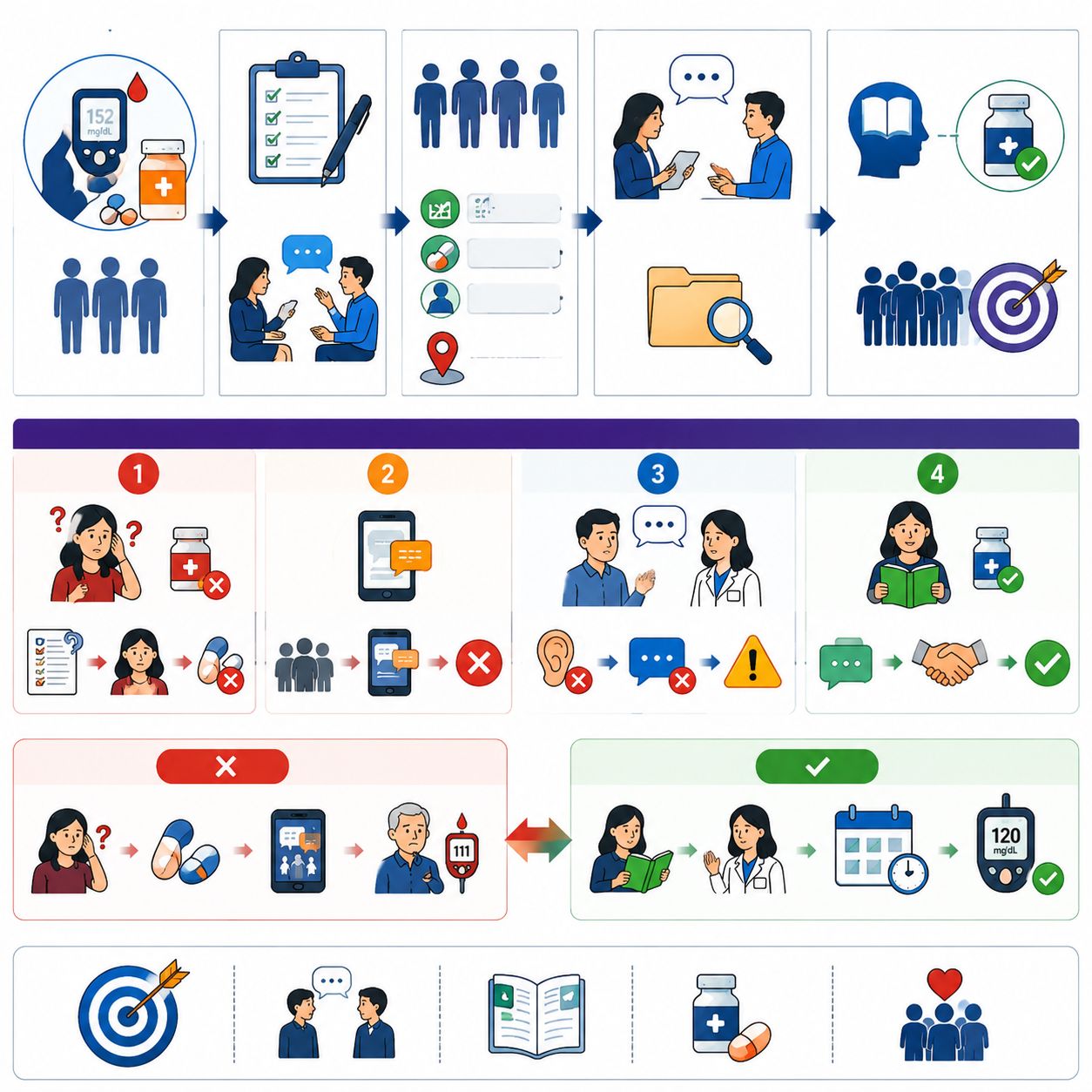
Type 2 diabetes mellitus is a chronic disease that requires lifelong medication adherence to prevent various complications. However, patients’ adherence to therapy remains a challenge, particularly among patients with low health literacy. This study aimed to explore the role of health literacy in medication adherence among patients with type 2 diabetes mellitus in Surabaya City. This study used a descriptive qualitative approach. A total of 15 participants were selected purposively from two primary healthcare centers based on the inclusion criteria, namely adult patients who had been diagnosed with type 2 diabetes mellitus for at least one year, were currently receiving antidiabetic therapy, and were willing to participate in in-depth interviews. Participant recruitment continued until data saturation was reached. Data were collected through semistructured interviews and analyzed using thematic analysis. The results identified four main themes, namely limited understanding of medication use, reliance on informal information sources, communication barriers with healthcare professionals, and health literacy as an empowering factor in diabetes management. The findings showed that low health literacy led to misunderstanding of medication instructions, non-adherence to therapy, and a tendency to follow health information from non-professional sources. Conversely, patients with better health literacy demonstrated more effective communication with healthcare professionals and were more consistent in following their treatment. This study concludes that strengthening health literacy through patient-centered communication and education tailored to patients’ literacy levels is an important strategy for improving medication adherence in primary healthcare services.
Downloads
References
Berkman, N. D., Sheridan, S. L., Donahue, K. E., Halpern, D. J., & Crotty, K. (2011). Low health literacy and health outcomes: An updated systematic review. Annals of Internal Medicine, 155(2), 97–107. https://doi.org/10.7326/0003-4819-155-2-201107190-00005
Braun, V., & Clarke, V. (2021). Thematic analysis: A practical guide. SAGE.
Cahyono, S. W. T. (2025). Self care management in diabetes mellitus sufferers at Nganjuk Community Health Center. Journal for Research in Public Health, 7(1), 8–13. https://doi.org/10.30994/jrph.v7i1.111
Chen, J., Tian, Y., Yin, M., Lin, W., Tuersun, Y., Li, L., Yang, J., Wu, F., Kan, Y., Li, X., Gan, Y., Sun, X., Wu, Y., & He, F. (2023). Relationship between self-efficacy and adherence to self-management and medication among patients with chronic diseases in China: A multicentre cross-sectional study. Journal of Psychosomatic Research, 164, 111105. https://doi.org/10.1016/j.jpsychores.2022.111105
Chong, C. J., Makmor-Bakry, M., Hatah, E., Mohd Tahir, N. A., Mustafa, N., Capule, F. R., & Hermansyah, A. (2025). A qualitative study of type 2 diabetes mellitus outpatients' perspectives on readiness, acceptance and barriers of mobile apps for medication adherence. Patient Education and Counseling, 131, 108547. https://doi.org/10.1016/j.pec.2024.108547
de Carvalho, A. C., Silva, M. T., Treptow, I. L. G., Latorraca, C. O. C., Pacheco, R. L., Dos Santos Valsecchi, V. A., Riera, R., & Cunha, L. L. (2025). Health literacy in patients with type 2 diabetes mellitus: A systematic review. Clinics, 80, 100774. https://doi.org/10.1016/j.clinsp.2025.100774
Hilyah, D., Kuswinarti, K., & Ramadhanti, J. (2025). Family support in adherence to oral anti-diabetic medications among patients with type 2 diabetes mellitus. Althea Medical Journal, 12(1), 22–27. https://doi.org/10.15850/amj.v12n1.3454
Hyvert, S., Yailian, A. L., Haesebaert, J., Vignot, E., Chapurlat, R., Dussart, C., De Freminville, H., & Janoly-Dumenil, A. (2023). Association between health literacy and medication adherence in chronic diseases: A recent systematic review. International Journal of Clinical Pharmacy, 45(1), 38–51. https://doi.org/10.1007/s11096-022-01470-z
International Diabetes Federation. (2021). IDF diabetes atlas (10th ed.). International Diabetes Federation. https://diabetesatlas.org
Iroegbu, C., Tuot, D. S., Lewis, L., & Matura, L. A. (2025). The influence of patient-provider communication on self-management among patients with chronic illness: A systematic mixed studies review. Journal of Advanced Nursing, 81(4), 1678–1699. https://doi.org/10.1111/jan.16492
Jimmy, B., & Jose, J. (2011). Patient medication adherence: Measures in daily practice. Oman Medical Journal, 26(3), 155–159. https://doi.org/10.5001/omj.2011.38
Ministry of Health Republic of Indonesia. (2024). Indonesia health profile 2023. Ministry of Health Republic of Indonesia.
Nutbeam, D. (2008). The evolving concept of health literacy. Social Science & Medicine, 67(12), 2072–2078. https://doi.org/10.1016/j.socscimed.2008.09.050
Nutbeam, D., McGill, B., & Premkumar, P. (2018). Improving health literacy in community populations: A review of progress. Health Promotion International, 33(5), 901–911. https://doi.org/10.1093/heapro/dax015
Pertiwi, M. V., Alfian, R., Nita, Y., & Athiyah, U. (2022). Medication adherence of diabetes mellitus patients in Indonesia: A systematic review. Pharmacy Education, 22(2), 188–193. https://doi.org/10.46542/pe.2022.222.188193
Poureslami, I., Nimmon, L., Rootman, I., & Fitzgerald, M. J. (2017). Health literacy and chronic disease management: Drawing from expert knowledge to set an agenda. Health Promotion International, 32(4), 743–754. https://doi.org/10.1093/heapro/daw003
Roshan-Nejad, M., Hosseini, M., Vasli, P., Nasiri, M., & Hejazi, S. (2025). Effect of health literacy-based teach-back training on quality of life and treatment adherence in type 2 diabetes: An experimental study. Scientific Reports, 15(1), 551. https://doi.org/10.1038/s41598-024-84399-9
Sandelowski, M. (2000). Whatever happened to qualitative description?. Research in nursing & health, 23(4), 334–340. https://doi.org/10.1002/1098-240X(200008)23:4%3C334::AID-NUR9%3E3.0.CO;2-G
Sriklo, M., & Sermsinsiri, K. (2026). Effects of a health literacy program on self-management behaviors of patients with uncontrolled type 2 diabetes in Thailand: A quasi-experimental study. Belitung Nursing Journal, 12(1), 97–105. https://doi.org/10.33546/bnj.4156
Veronika, E. N. (2024). The influence of family support on therapy adherence in diabetes patients: A mixed-methods study. International Journal on Health and Medical Sciences, 2(3), 114–123. https://doi.org/10.35335/healmed.v2i3.332
Vidiani, A. A. P. P., & Puspitaningrum, A. N. (2023). Analysis of health literacy of type 2 diabetes mellitus patients with oral antidiabetic therapy at Surabaya community health centers. Journal of Pharmaceutical and Sciences, 6(5), 456–460. https://doi.org/10.36490/journal-jps.com.v6i5-si.413
World Health Organization. (2022). Health literacy development for the prevention and control of noncommunicable diseases. World Health Organization. https://www.who.int
Wu, M., Wang, W., He, H., Bao, L., & Lv, P. (2025). Mediating effects of health literacy, self-efficacy, and social support on the relationship between disease knowledge and patient participation behavior among chronic ill patients: A cross-sectional study based on the capability-opportunity-motivation and behavior (COM-B) model. Patient Preference and Adherence, 19, 1337–1350. https://doi.org/10.2147/PPA.S513375
Downloads
Published
How to Cite
Issue
Section
License
Copyright (c) 2026 Eka Nasrur Maulana, Mira Kusuma Wardhani

This work is licensed under a Creative Commons Attribution-ShareAlike 4.0 International License.