Impact of Bitter Palm Wine Types on Surface Roughness of Heat-Cured Acrylic Resin
DOI:
https://doi.org/10.58184/miki.v4i2.947Keywords:
fermentation, surface roughness, heat-cured acrylic resin, bitter palm wineAbstract
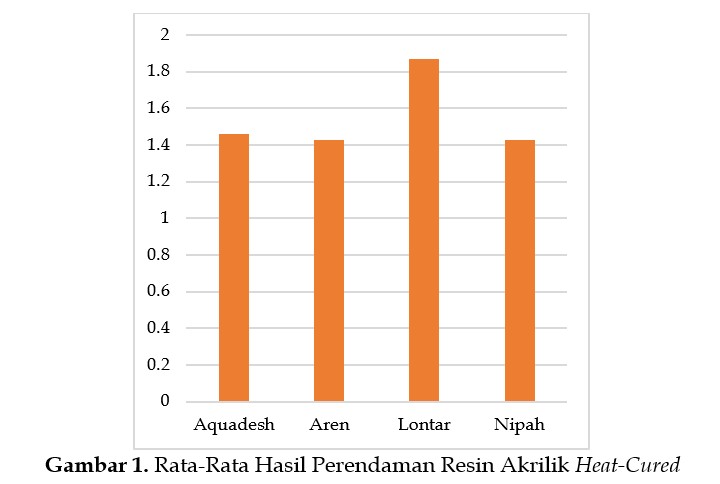
Heat-cured acrylic resin is widely used as a denture base material due to its favorable esthetics, biocompatibility, and ease of manipulation. However, this material has water absorption properties, and exposure to acidic and alcoholic solutions may affect its surface roughness. Bitter palm wine derived from aren, lontar, and nipah contains alcohol and has an acidic nature that may interact with the surface of acrylic resin. This study aimed to analyze the effect of immersion in three types of bitter palm wine on the surface roughness of heat-cured acrylic resin denture bases. This laboratory experimental study employed a pretest–posttest with control group design. A total of 24 heat-cured acrylic resin plates measuring 30 × 10 × 2 mm were divided into four groups: distilled water as the control group and bitter palm wine from aren, lontar, and nipah as treatment groups. Surface roughness was measured before and after immersion using a Surface Roughness Tester (SRT). Data were analyzed using the One Way ANOVA and LSD tests. Surface roughness values varied among the immersion groups. However, statistical analysis showed no significant difference between groups (p = 0.778). Descriptively, immersion in bitter palm wine showed a tendency to alter the surface roughness of heat-cured acrylic resin, although the effect was not statistically significant.
Downloads
References
Aisyah, S, S., Hasyimuddin, H., & Samsinar, S. (2018). Uji Alkohol Pada Fermentasi Tuak. Teknosains: Media Informasi Sains Dan Teknologi, 12(2), 148–156. https://doi.org/10.24252/teknosains.v12i2.7594
Al Hatem, O., Ontiveros, J. C., Belles, D. M., Gonzalez, M. D., & van der Hoeven, R. (2025). Surface Roughness and Microbial Adhesion on Four Provisional Prosthodontic Restorative Materials. Dentistry Journal, 13(11), 498. https://doi.org/10.3390/dj13110498
Alqarawi, F. K., & Gad, M. M. (2024). Tendency of microbial adhesion to denture base resins: a systematic review. Frontiers in Oral Health, 5, 1375186. https://doi.org/10.3389/froh.2024.1375186
Barlina, R., Liwu, S., & Manaroinsong, E. (2020). Potensi dan teknologi pengolahan komoditas aren sebagai produk pangan dan nonpangan. Jurnal Litbang Pertanian, 39(1), 35–47. https://doi.org/10.21082/jp3.v39n1.2020.p35-47
Camargo, R., Oliveira, J. S. D., Ferro, A. C., Ribas, B. R., Alves, A. A. V., & Jorge, J. H. (2025). Surface Changes Induced by Brushing Increase Candida albicans Biofilms on 3D-Printed Denture Base Resin. Journal of Fungi, 11(9), 668. https://doi.org/10.3390/jof11090668
Costa, R. T. F., Pellizzer, E. P., Vasconcelos, B. C. D. E., Gomes, J. M. L., Lemos, C. A. A., & de Moraes, S. L. D. (2021). Surface roughness of acrylic resins used for denture base after chemical disinfection: A systematic review and meta‐analysis. Gerodontology, 38(3), 242–251. https://doi.org/10.1111/ger.12529
Lee, J. E., & Kim, J. H. (2019). Chemistry of the Korean traditional alcoholic beverage Makgeolli. In C. H. Do, A. M. Rimando, & Y. Kim (Eds.), Chemistry of Korean foods and beverages (ACS Symposium Series, Vol. 1303, pp. 97–103). American Chemical Society. https://doi.org/10.1021/bk-2019-1303.ch007
Ikhwana, N., & Nawireja, I. K. (2021). Mengapa Masyarakat Memproduksi Minuman Beralkohol Tradisional?. Jurnal Sains Komunikasi Dan Pengembangan Masyarakat [JSKPM], 5(6), 809–826. https://doi.org/10.29244/jskpm.v5i06..920
Kementerian Kesehatan Republik Indonesia. (2018). Hasil utama Riskesdas 2018. Badan Penelitian dan Pengembangan Kesehatan.
Krisnanto, W., Faila, R. N., & Anshori, M. (2023). Kualitas Bioetanol Tuak Tuban Dari Nira Siwalan (Borassus Flabellifer Linn) Dengan Metode Fermentasi Sebagai Bahan Bakar Alternatif. Journal of Mechanical Engineering and Applied Technology, 3(1), 25–30. https://doi.org/10.32497/jmeat.v3i1.6505
Lidiawati, D., Mubarak, S., & Khaerani, N. (2024). Analisis Kadar Alkohol Nira Manis Pohon Aren (Arenga pinnata Merr). Arfak Chem: Chemistry Education Journal, 7(2), 633–640. https://doi.org/10.30862/accej.v7i2.782
Rizki, G. A., Wahyuningsih, S., & Mozartha, M. (2020). The effect of alcoholic beverages on surface roughness of acrylic denture base material. Sound of Dentistry (SONDE), 5(1), 1–8. https://doi.org/10.28932/sod.v5i1.2328
Savitri, R. P. A., Naini, A., Parnaadji, R., & Kristiana, D. (2022). Pengaruh Lama Perendaman Resin Akrilik Heat Cured pada Ekstrak Daun Tembakau (Nicotiana tabacum) 50% terhadap Perubahan Warna. Padjadjaran Journal of Dental Researchers and Students, 6(3), 290–297. https://doi.org/10.24198/pjdrs.v6i3.40556
Turanoglu, O. F., Talay Cevlik, E., & Vural, C. (2024). Investigation of adhesion status of Candida species to the surface of resin materials produced at different angles with additive manufacturing. BMC Oral Health, 24(1), 738. https://doi.org/10.1186/s12903-024-04505-1
Zafar, M. S. (2020). Prosthodontic applications of polymethyl methacrylate (PMMA): An update. Polymers, 12(10), 2299. https://doi.org/10.3390/polym12102299
Downloads
Published
How to Cite
Issue
Section
License
Copyright (c) 2026 Nur Aedah Ahmad Rani, Firman, Aisyah AR

This work is licensed under a Creative Commons Attribution-ShareAlike 4.0 International License.