Analysis of Sun Protection Factor (SPF) values of Shallot Leaf Extract using UV-Vis Spectroscopy Method
DOI:
https://doi.org/10.58184/miki.v4i1.823Keywords:
shallots leaf, SPF, erythema transmission, pigmentation transmission, UV-VisAbstract
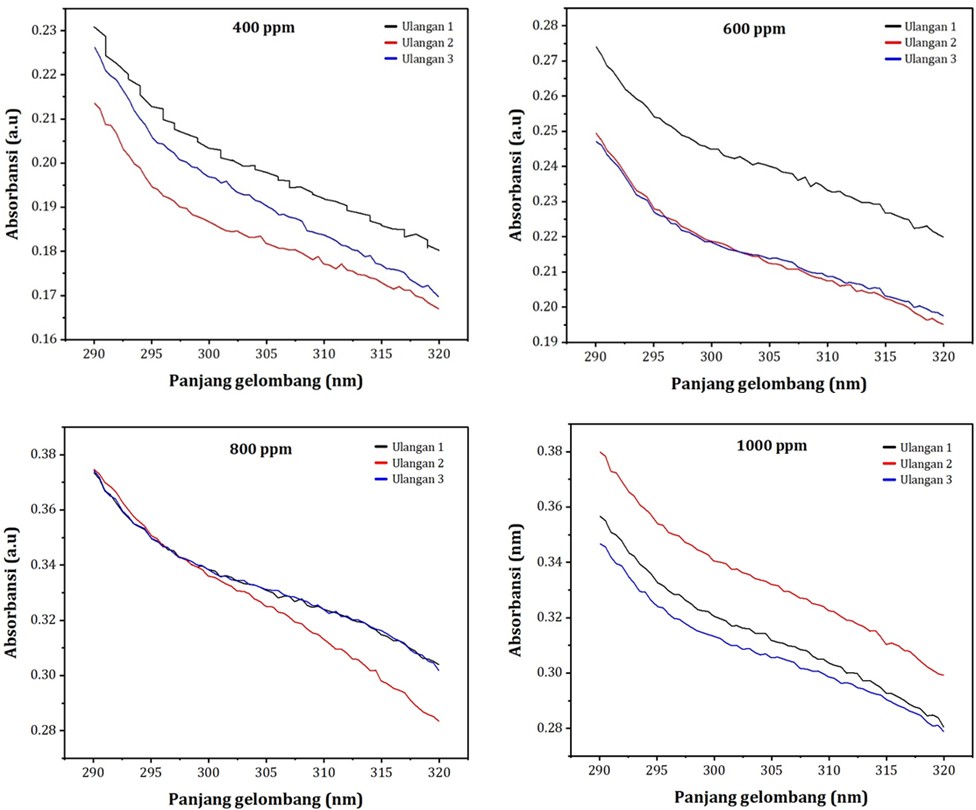
A study has been conducted on measuring the sun protection potential of red onion leaf extract with the percentage of pigmentation transmission (%Tp), erythema transmission (%Te), and Sun Protection Factor (SPF) using the UV-Vis Spectrophotometry method. The purpose of this study was to classify the sun protection potential categories of shallot leaf extract. The sunscreen ability test was determined by the calculation method of erythema transmission, pigmentation transmission, and SPF in the wavelength range of 290-320 nm with a distance of 5 nm. From the test, the concentrations of 400 ppm, 600 ppm, 800 ppm, and 1000 ppm were obtained which were included in the Extra Protection category for pigmentation based on the values (%Tp) which were 63.70%, 60.15%, 46.15%, and 47.45%, respectively, all of which were in the Extra Protection category (42 – 86%). The erythema values for each were 63.57%, 59.14%, 45.96%, and 47.31%, respectively. The SPF values were categorized as Minimal Protection with values at concentrations of 400 ppm (1.903), 600 ppm (2.219), 800 ppm (3.284), and 1000 ppm (3.161). The UV protection effectiveness of shallot leaf extract was highly sensitive to pH changes and reached optimum conditions at a pH close to neutral, around 7.07.
Downloads
References
Addor, F. A. S. A., Barcaui, C. B., Gomes, E. E., Lupi, O., Marçon, C. R., & Miot, H. A. (2022). Sunscreen lotions in the dermatological prescription: review of concepts and controversies. Anais brasileiros de dermatologia, 97(2), 204-222. https://doi.org/10.1016/j.abd.2021.05.012
Adeyemo, A. E., Omoba, O. S., Olagunju, A. I., & Josiah, S. S. (2023). Assessment of nutritional values, phytochemical content, and antioxidant properties of Shallot (Allium ascalonicum L.) leaf and bulb. Phytochemical Content, and Antioxidant Properties of Shallot (Allium Ascalonicum L.) Leaf and Bulb. Measurement: Food, 10, 100091. https://doi.org/10.1016/j.meafoo.2023.100091
Adiwibowo, M. T., Firliyani, S. T., Ma’rifah, N., Kanani, N., Wardalia, W., Pitaloka, A. B., & Pramudita, M. (2023). Extraction of Flavonoid, Phenolic, and Saponin in Shallot Skin (Allium cepa Var. Aggregatum) for Antibacterial Application. CHEMICA: Jurnal Teknik Kimia, 10(1), 1-8. https://doi.org/10.26555/chemica.v10i1.23425
Alsalamah, S. A., Alghonaim, M. I., Abdelghany, T. M., Almehayawi, M. S., Selim, S., & Alharbi, M. T. (2025). Effect of UV-C radiation on chemical profile and pharmaceutical application in vitro of Aloe vera oil. AMB Express, 15(1), 83. https://doi.org/10.1186/s13568-025-01884-8
Amiarsi, D., Sasmitaloka, K. S., Arif, A. B., & Widayanti, S. M. (2019). Curing Process Modification of Shallot Through Cutting Leaves. IOP Conference Series: Earth and Environmental Science, 309(1), 012022. https://doi.org/10.1088/1755-1315/309/1/012022
Chavda, V. P., Acharya, D., Hala, V., Daware, S., & Vora, L. K. (2023). Sunscreens: A comprehensive review with the application of nanotechnology. Journal of Drug Delivery Science and Technology, 86, 104720. https://doi.org/10.1016/j.jddst.2023.104720
Dewi, D. A. R. (2022). Sunscreen Protection Against Visible Light: Is It Needed?. Malahayati Nursing Journal, 4(10), 2527-2536. https://doi.org/10.33024/mnj.v4i10.7068
Fauziyyah, R. N. P., Komariah, M., & Herliani, Y. K. (2023). Sunlight exposure and protection behavior as prevention of skin cancer in nursing students. Indonesian Journal of Cancer, 17(1), 1-8. https://doi.org/10.33371/ijoc.v17i1.921
Gromkowska‐Kępka, K. J., Puścion‐Jakubik, A., Markiewicz‐Żukowska, R., & Socha, K. (2021). The impact of ultraviolet radiation on skin photoaging—review of in vitro studies. Journal of cosmetic dermatology, 20(11), 3427-3431. https://doi.org/10.1111/jocd.14033
Guan, L. L., Lim, H. W., & Mohammad, T. F. (2022). Recognizing photoallergy, phototoxicity, and immune-mediated photodermatoses. Journal of Allergy and Clinical Immunology, 149(4), 1206-1209. https://doi.org/10.1016/j.jaci.2022.02.013
Hart, P. H., & Norval, M. (2021). More than effects in skin: ultraviolet radiation-induced changes in immune cells in human blood. Frontiers in immunology, 12, 694086. https://doi.org/10.3389/fimmu.2021.694086
Jannah, H. (2022). Uji Aktivitas Peredaman Radikal Bebas DPPH (1,1-Difenil-2Pikrilhidrazil) dan Potensi Tabir Surya Ekstrak/1Etil Asetat Rimpang Lempuyang Gajah/1(Zingiber Zerumbet (L). Smith). [Skripsi, Universitas Islam Negeri Alauddin Makassar]. UIN Makassar Repositori.
Khan, M. A. (2018). Sun protection factor determination studies of some sunscreen formulations used in cosmetics for their selection. Journal of Drug Delivery and Therapeutics, 8(2), 149-151. https://doi.org/10.22270/jddt.v8i5-s.1924
Kusumanti, D. P., Sayuti, N. A., & As, I. (2017). Aktivitas tabir surya formula bedak dingin Jawa. Indonesian Journal of Pharmaceutical Science and Technology, 1(1), 01-07. https://doi.org/10.15416/ijpst.v1i1.12156
Major, N., Perković, J., Palčić, I., Bažon, I., Horvat, I., Ban, D., & Goreta Ban, S. (2022). The phytochemical and nutritional composition of shallot species (Allium× cornutum, Allium× proliferum and A. cepa aggregatum) is genetically and environmentally dependent. Antioxidants, 11(8), 1547. https://doi.org/10.3390/antiox11081547
Maverakis, E., Miyamura, Y., Bowen, M. P., Correa, G., Ono, Y., & Goodarzi, H. (2010). Light, including ultraviolet. Journal of autoimmunity, 34(3), J247-J257. https://doi.org/10.1016/j.jaut.2009.11.011
Mbanga, L., Mulenga, M., Mpiana, P. T., Bokolo, K., Mumbwa, M., & Mvingu, K. (2014). Determination of sun protection factor (SPF) of some body creams and lotions marketed in Kinshasa by ultraviolet spectrophotometry. Int. J. Adv. Res. Chem. Sci, 1(8), 7-13.
Mumtaz, S., Ali, A., Sharif, H. M., Aljowaie, R. M., Alsaleh, A. N., Khan, H., Naeem, M., & Abbasi, A. M. (2023). Assessment of sunscreen effects in photosensitivity under UV exposure during COVID-19 pandemic. Journal of King Saud University-Science, 35(10), 102970. https://doi.org/10.1016/j.jksus.2023.102970
Muscolo, A., Maffia, A., Marra, F., Battaglia, S., Oliva, M., Mallamaci, C., & Russo, M. (2025). Unlocking the Health Secrets of Onions: Investigating the Phytochemical Power and Beneficial Properties of Different Varieties and Their Parts. Molecules, 30(8), 1758. https://doi.org/10.3390/molecules30081758
Pai, S. B., & Anchan, V. N. (2024). Phototoxicity and photoallergy–A brief review on pathogenesis, recent advances, and approach to a patient with photosensitivity. Indian Journal of Skin Allergy, 3(1), 28-35. https://doi.org/10.25259/IJSA_9_2024
Pramiastuti, O. (2019). Penentuan Nilai SPF (Sun Protection Factor) Ekstrak dan Fraksi Daun Kecombrang (Etlingera elatior) Secara in Vitro Menggunakan Metode Spektrofotometri. Parapemikir: Jurnal Ilmiah Farmasi, 8(1), 14-18. https://doi.org/10.30591/pjif.v8i1.1281
Ramdan, S. R. K., Purwanti, D., Kurniasih, N., & Harun, N. (2023). Formulasi dan Nilai SPF Krim Tabir Surya Kombinasi Ekstrak Pegagan (Centella asiatica L.) dengan Tio2. Medical Sains: Jurnal Ilmiah Kefarmasian, 8(2), 373-382. https://doi.org/10.37874/ms.v8i2.302
Romanhole, R. C., Ataide, J. A., Moriel, P., & Mazzola, P. G. (2015). Update on ultraviolet A and B radiation generated by the sun and artificial lamps and their effects on skin. International journal of cosmetic science, 37(4), 366-370. https://doi.org/10.1111/ics.12219
Salih, H., Psomadakis, C., & George, S. M. C. (2024). Sunscreens: A narrative review. Skin Health and Disease, 4(6), 1-10. https://doi.org/10.1002/ski2.432
Shanbhag, S., Nayak, A., Narayan, R., & Nayak, U. Y. (2019). Anti-aging and sunscreens: paradigm shift in cosmetics. Advanced pharmaceutical bulletin, 9(3), 348-359. https://doi.org/10.15171/apb.2019.042
Singh, P., & Mishra, S. (2025). Impact of UV Radiation on Human Health. Industrial Engineering Journal, 54(3), 1-6.
Sulistiyowati, A., Yushardi, Y., & Sudarti, S. (2022). Potensi Keberagaman SPF (Sun Protection Factor) Sunscreen terhadap Perlindungan Paparan Sinar Ultraviolet Berdasarkan Iklim di Indonesia. Jurnal Bidang Ilmu Kesehatan, 12(3), 261-269. https://doi.org/10.52643/jbik.v12i3.2196
Tang, X., Yang, T., Yu, D., Xiong, H., & Zhang, S. (2024). Current insights and future perspectives of ultraviolet radiation (UV) exposure: Friends and foes to the skin and beyond the skin. Environment international, 185, 108535. https://doi.org/10.1016/j.envint.2024.108535
Ulfa, U., Wiraningtyas, A., Mutmainnah, P., Agustina, S., Fariati, F., Julkaidah, J., & Bulan, S. (2022). Kajian Penentuan Nilai Sun Protection Factor (SPF) dari Ekstrak Rumput Laut Sargassum sp. Menggunakan Spektrofotometer Uv-Vis. Jurnal Redoks: Jurnal Pendidikan Kimia Dan Ilmu Kimia, 5(2), 39-46. https://doi.org/10.33627/re.v5i2.802
Verma, A., Zanoletti, A., Kareem, K. Y., Adelodun, B., Kumar, P., Ajibade, F. O., Silva, L. F. O., Phillips, A. J., Kartheeswaran, T., Bontempi, E., & Dwivedi, A. (2024). Skin protection from solar ultraviolet radiation using natural compounds: a review. Environmental Chemistry Letters, 22(1), 273-295. https://doi.org/10.1007/s10311-023-01649-4
Wilson, B. D., Moon, S., & Armstrong, F. (2012). Comprehensive review of ultraviolet radiation and the current status on sunscreens. The Journal of clinical and aesthetic dermatology, 5(9), 18-23.
Yang, J. W., Fan, G. B., Tan, F., Kong, H. M., Liu, Q., Zou, Y., & Tan, Y. M. (2023). The role and safety of UVA and UVB in UV-induced skin erythema. Frontiers in Medicine, 10, 1163697. https://doi.org/10.3389/fmed.2023.1163697
Downloads
Published
How to Cite
Issue
Section
License
Copyright (c) 2026 Hajra, Jumardin, Ihsan

This work is licensed under a Creative Commons Attribution-ShareAlike 4.0 International License.